Plan Smarter. Grow Stronger. Don’t miss our latest financial strategies. →
Read the latest blog posts.png)
December 22, 2025
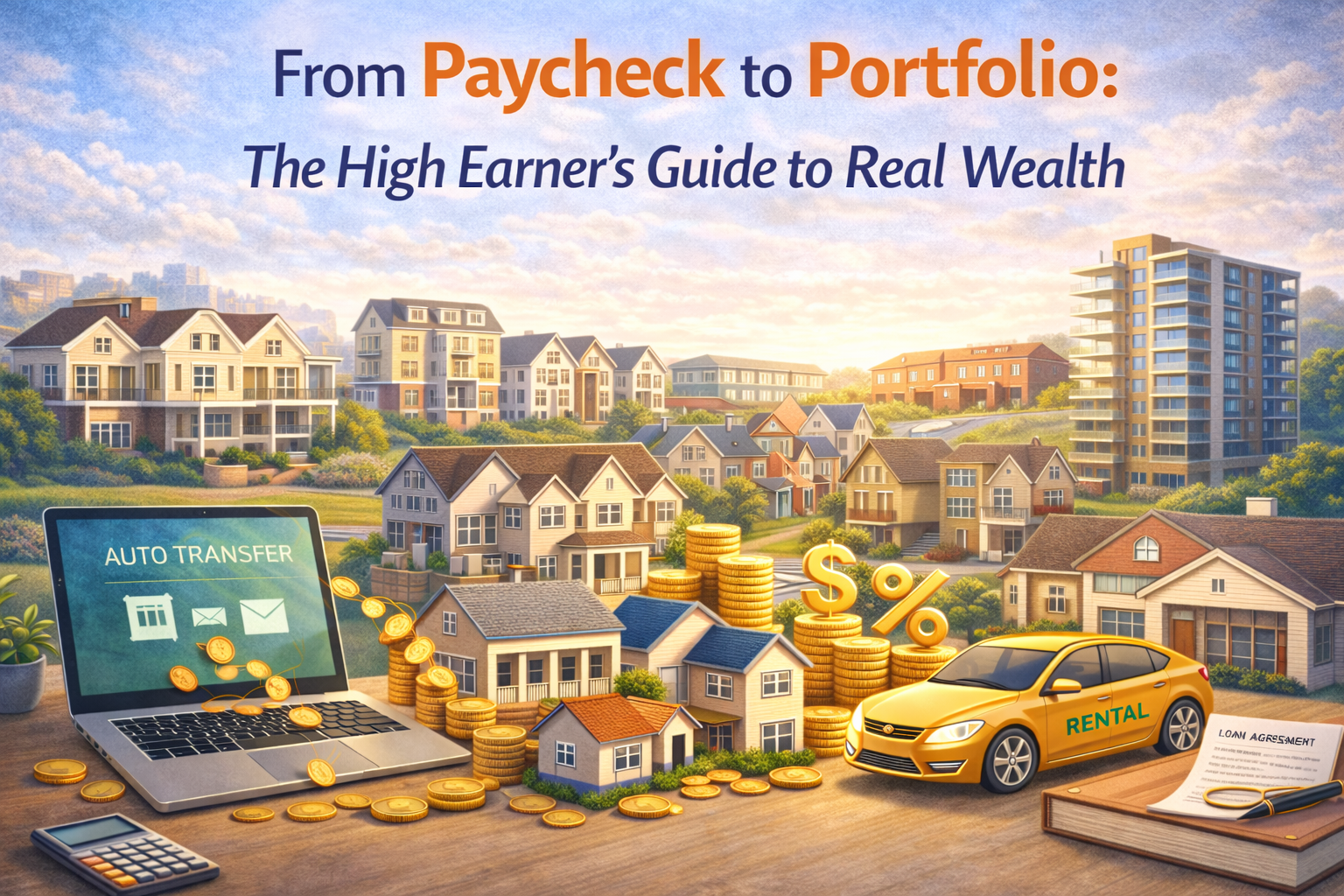
From Paycheck to Portfolio: The High Earner's Guide to Real Wealth
You've made it.
Six figures. Maybe more. The kind of income that used to feel impossible. The kind your parents would have called "set for life."
But here's what nobody told you:
A big paycheck doesn't equal wealth. It just equals a big paycheck.
You can make $200K a year and still be one layoff, one medical crisis, one market downturn away from financial stress. Because if your income stops, everything stops.
That's not wealth. That's high-income fragility.
Real wealth isn't about how much you make. It's about what you own.
It's the difference between being paid well and being financially free. Between earning money and having money work for you. Between a paycheck and a portfolio.
And if you're still in paycheck mode—even a great one—you're leaving the most important part of wealth-building on the table.
Let's fix that.
The Trap of the High-Income Earner
Here's the pattern:
You get the promotion. The raise. The bonus. Your income climbs from $80K to $120K to $180K to $250K.
And every time it goes up, so does everything else:
- Bigger house
- Nicer car
- Better vacations
- Private schools
- Country club membership
Your lifestyle scales with your income. And suddenly, you're making a quarter-million dollars a year and still living paycheck to paycheck.
You look successful. You feel stressed.
This is called lifestyle creep—and it's the silent killer of wealth.
Because here's the truth: Income is not wealth. Income is the raw material for building wealth.
And if you're spending everything you make—no matter how much you make—you're not building anything. You're just funding a more expensive version of the same trap.
Paycheck Thinking vs. Portfolio Thinking
Let's break down the difference:
Paycheck Thinking:
- "How much do I make per year?"
- "What can I afford based on my salary?"
- "I'll save what's left after expenses."
- "My 401(k) is my plan."
- "I need this job to maintain my lifestyle."
Result: High income, low freedom. Golden handcuffs. Dependency.
Portfolio Thinking:
- "How much passive income do my assets generate?"
- "What can I buy that will pay me every month?"
- "I invest first, spend what's left."
- "My portfolio is my plan—the 401(k) is just one piece."
- "My assets cover my lifestyle. My job is optional."
Result: High income and high freedom. Optionality. Independence.
The shift from paycheck to portfolio isn't about making more. It's about keeping more and deploying it smarter.
The 3 Pillars of Portfolio Thinking
If you want to build real wealth—the kind that outlasts your job, survives market downturns, and gives you actual freedom—you need to build across three pillars:
Pillar 1: Cash Flow (Income That Doesn't Require You)
This is the foundation. Cash flow is money that shows up every month whether you work or not.
Examples:
- Rental property income
- Dividend payments
- Interest from private lending
- Royalties or licensing fees
- Business income (if systematized)
Why it matters: Cash flow covers your life. It's the difference between "I have to work" and "I choose to work."
The goal: Build enough monthly cash flow to cover your baseline expenses. Once you hit that number, your job becomes optional.
Pillar 2: Equity Growth (Wealth That Compounds)
Cash flow pays the bills. Equity builds generational wealth.
Examples:
- Real estate appreciation
- Stock portfolio growth
- Business valuation increases
- Retirement accounts (401(k), IRA, Roth)
Why it matters: Equity is how you go from comfortable to wealthy. It's the long-term compounding engine that turns $500K into $2M into $5M over decades.
The goal: Own assets that appreciate over time while producing income today.
Pillar 3: Tax Efficiency (Keeping What You Make)
You can make $300K and keep $180K after taxes—or make $300K and keep $240K after taxes. Same income. $60K difference.
Examples:
- Real estate depreciation (offsets W-2 income)
- Roth accounts (tax-free growth and withdrawals)
- Strategic tax-loss harvesting
- Deductions through business ownership
Why it matters: Every dollar you save in taxes is a dollar that compounds for you, not the IRS.
The goal: Minimize your lifetime tax burden through legal, strategic planning.
The 5-Step Roadmap: From Paycheck to Portfolio
Step 1: Stop Inflating Your Lifestyle
Every time your income increases, you have a choice:
- Option A: Upgrade your life (bigger house, nicer car, fancier dinners)
- Option B: Upgrade your assets (more investments, more cash flow, more freedom)
Most people choose Option A by default. Wealth-builders choose Option B intentionally.
The rule: Live on 70–80% of your income. Invest the rest.
Action step: The next time you get a raise or bonus, commit to investing at least 50% of it before you spend a dime.
Step 2: Build Your Cash Flow Foundation
Your first goal is simple: Generate $1,000/month in passive income.
That might not sound like much—but it's proof of concept. It's the first crack in the paycheck dependency.
How to get there:
- Option 1: Buy one rental property that cash flows $300–$500/month. Add a second. You're at $1,000.
- Option 2: Invest $250K in dividend stocks yielding 4–5%. That's $10K–$12.5K/year = $833–$1,041/month.
- Option 3: Invest $100K in a real estate syndication yielding 7–8%. That's $7K–$8K/year = $583–$666/month. Add a second investment. You're over $1,000.
Once you hit $1,000/month, you've proven the model. Now you scale.
Step 3: Diversify Your Income Streams
Don't put all your wealth in one basket.
The ideal portfolio has multiple income sources:
- W-2 income (your job—for now)
- Real estate cash flow (rental properties or syndications)
- Dividend income (stocks, REITs, index funds)
- Business or side income (consulting, royalties, etc.)
- Interest income (private lending, bonds)
Why it matters: If one stream dries up, you're not in crisis. You're diversified across asset classes, tax treatments, and risk profiles.
Action step: Audit your current income sources. If 100% comes from your job, you're over-concentrated. Start building stream #2 this quarter.
Step 4: Shift From Net Worth Goals to Cash Flow Goals
Most people measure wealth by net worth. That's fine—but it's incomplete.
Net worth is a scorecard. Cash flow is freedom.
Here's the shift:
- Old goal: "I want to have $2 million by age 55."
- New goal: "I want $8,000/month in passive income by age 50."
Why it matters: You can have $2 million and still be broke if it's all locked in a 401(k) or your primary residence. But $8,000/month in cash flow? That's freedom you can use today .
Action step: Define your Time Freedom Number (monthly expenses + 10% buffer). Then build a plan to hit that number with assets, not age.
Step 5: Automate the Transition
Wealth isn't built by motivation. It's built by systems.
Here's the system:
- Auto-transfer 20% of every paycheck into your investment account (before you see it)
- Auto-invest in dividend stocks, index funds, or REITs (set it and forget it)
- Schedule a monthly "portfolio review"—30 minutes to track cash flow, analyze deals, and plan next moves
- Reinvest all passive income for the first 3–5 years (compound aggressively)
- Hire help (property managers, CPAs, advisors) so you're not doing everything yourself
The result: Your portfolio grows whether you're motivated or not. Whether you're busy or not. Whether the market is up or down.
What This Looks Like in Real Life
Year 1–2: The Foundation
- You're still working full-time, making $150K–$250K
- You acquire 1–2 rental properties or invest $50K–$100K in cash-flowing assets
- Passive income: $500–$1,200/month
- You're covering 10–20% of your expenses
Year 3–5: The Acceleration
- You reinvest cash flow and continue acquiring assets
- You now own 3–5 properties or have $200K–$400K deployed in income-producing investments
- Passive income: $2,500–$4,500/month
- You're covering 40–70% of your expenses
Year 6–10: The Transition
- Your portfolio is mature and diversified
- Passive income: $6,000–$10,000/month
- You're covering 100%+ of your expenses
- Your job is now optional
You can keep working if you love it. You can go part-time. You can pivot to something lower-paying but more fulfilling. You can retire early.
The choice is yours—because your portfolio gives you options.
Here's the Truth:
A big paycheck is a gift. But it's not the goal.
The goal is to convert that paycheck into assets that pay you —so you're not dependent on the next promotion, the next bonus, the next performance review.
Real wealth isn't about how much you make. It's about how much works for you while you sleep.
And the shift from paycheck to portfolio isn't complicated. It's just intentional.
Stop spending everything you make. Start buying things that pay you. Build cash flow, equity, and tax efficiency in parallel.
Do that, and you're not just earning well—you're building freedom.
Ready to make the shift from paycheck to portfolio?
The Financial Freedom Accelerator is an 8-week, live coaching experience that teaches you how to turn your high income into a cash-flowing portfolio—without quitting your job or gambling on get-rich-quick schemes.
Led by investor and mentor Erik Hitzelberger, you'll learn how to acquire income-producing assets, reduce your taxes, and build a plan that actually leads to freedom.
Learn More About Financial Freedom Accelerator
Because your paycheck got you here.
Your portfolio will set you free.

.jpg)

Book Your Freedom Call

Client Success First
FPG Academy has taught entire groups of people and individuals how to think differently about money and investing.

Done-with-You Financial Options
We tailor every plan to your unique goals, ensuring you always receive the education that fits your goals.
.svg)
Clear, Ongoing Support
With interactive courses, supportive digital products, and access to educators within FPG Academy, we make sure all your questions get answered.
© 2025 FPG Academy All rights reserved.
Website design by My Launch Partner.svg)
.svg)
.svg)