Plan Smarter. Grow Stronger. Don’t miss our latest financial strategies. →
Read the latest blog posts.png)
December 15, 2025
How to Build Passive Income Without Quitting Your Day Job
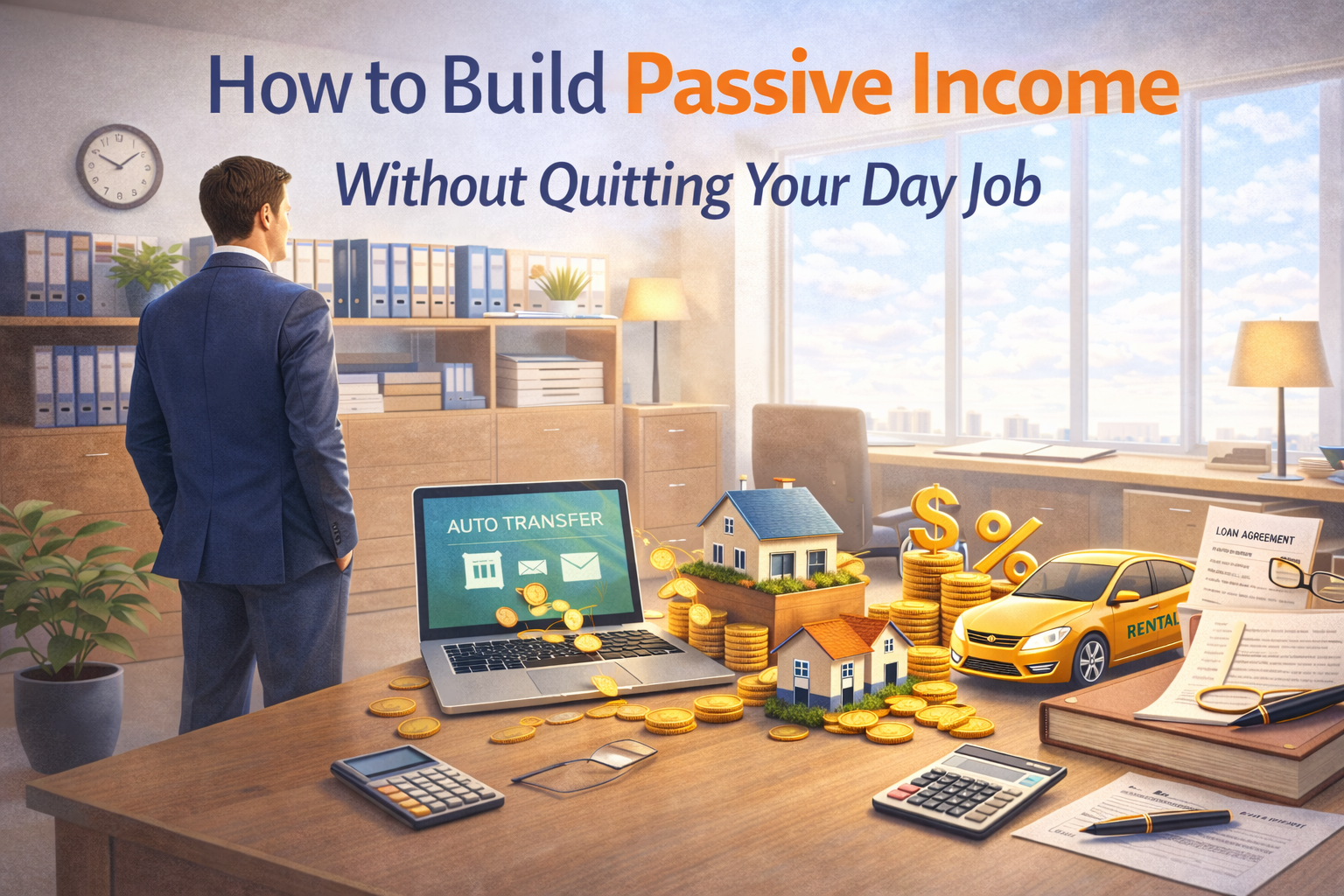
You're trapped in the middle.
You make good money. The job is stable. The benefits are solid. People would kill for your position.
But you're exhausted.
You're tired of the meetings that could have been emails. The politics. The performance reviews. The feeling that no matter how hard you work, you're still just one restructuring away from starting over.
You dream about passive income. About waking up and checking your phone to see money that arrived while you slept. About having options—real options—that don't involve asking permission or hoping your boss is in a good mood.
But here's the problem:
You can't just quit. You have a mortgage. Kids. Responsibilities. And despite what the Instagram gurus say, you're not about to YOLO your life savings into crypto or drop everything to "build your empire."
You need a plan that works while you work.
Here's the good news: You don't have to quit your job to build passive income. You just have to start building it alongside your job—so that one day, the job becomes optional.
Let's talk about how.
First, Let's Define "Passive Income" (Because Most People Get It Wrong)
Passive income isn't:
- Money that requires zero effort forever
- A get-rich-quick scheme
- Something that happens overnight
Real passive income is income that doesn't require you to trade hours for dollars.
It's money that shows up because you own an asset—not because you clocked in.
- Rental properties pay you whether you go to work or not
- Dividend stocks pay you whether the market is open or closed
- A business with systems runs whether you're in the office or on vacation
The goal: Build enough passive income to cover your expenses—so your job becomes a choice, not a necessity.
Why High Earners Are Perfectly Positioned (But Often Don't Act)
If you're making $100K–$300K+ per year, you have something most people don't:
- Capital (you can save, invest, and deploy money)
- Credit (banks will lend to you at favorable rates)
- Capacity (you can take on debt and manage risk)
But here's the trap:
Most high earners are so busy earning that they never build. They're on the treadmill—making great money, spending most of it, and hoping the 401(k) works out in 25 years.
You don't have an income problem. You have a deployment problem.
The question isn't "Can I afford to invest?" It's "What am I doing with the income I already have?"
The 5-Step Framework to Build Passive Income While You Work
Step 1: Calculate Your Time Freedom Number
Before you start investing randomly, you need a target.
Your Time Freedom Number = the monthly passive income that covers your baseline expenses.
Here's how to calculate it:
- Add up your essential monthly expenses (mortgage, utilities, food, insurance, etc.)
- Add 10–15% buffer
- That's your number
Example:
- Monthly expenses: $6,000
- Buffer (10%): $600
- Time Freedom Number: $6,600/month
Now you have a goal. You're not chasing "passive income"—you're chasing $6,600/month. That's concrete. That's achievable. That's a plan.
Action step: Write down your Time Freedom Number today. This is your North Star.
Step 2: Redirect Income Into Assets (Not Lifestyle)
Here's the pattern that keeps people stuck:
- Get a raise → upgrade the car
- Get a bonus → bigger vacation
- Get a promotion → bigger house
Every time your income goes up, your expenses go up—so you never get ahead.
The wealth-building pattern:
- Get a raise → increase your auto-investment by the same percentage
- Get a bonus → 50% goes to your next asset purchase
- Get a promotion → keep living on your old salary, invest the difference
This is how you build passive income without feeling deprived: You're not cutting back—you're just not inflating your lifestyle every time you earn more.
Action step: Commit to investing at least 20% of every raise, bonus, or windfall into cash-flowing assets before you spend a dime.
Step 3: Start With the Easiest, Most Accessible Assets
You don't need to buy a 10-unit apartment building tomorrow. Start with what's accessible and scalable.
Option 1: Dividend-Paying Stocks (Liquid, Easy, Scalable)
- Open a taxable brokerage account
- Invest in dividend aristocrats (companies that have paid and increased dividends for 25+ years)
- Reinvest dividends automatically (DRIP) to compound faster
Example:
- Invest $50K in a diversified dividend portfolio yielding 4%
- That's $2,000/year = $166/month in passive income
- Reinvest for 10 years and you could be generating $400–$500/month
Pros: Liquid, low maintenance, no tenants
Cons: Taxed as income, market-correlated, slower to scale
Option 2: Real Estate (Cash Flow, Tax Benefits, Leverage)
This is the most powerful wealth-building tool for high earners—because you get:
- Monthly cash flow (income you can use)
- Appreciation (wealth building over time)
- Depreciation (tax deductions that offset W-2 income)
- Leverage (use the bank's money to amplify returns)
How to start:
- Get pre-approved with a lender (know your buying power)
- Define your buy box (location, price range, property type)
- Analyze 10 deals/week using a simple cash flow calculator
- Make offers on properties that meet your criteria
- Hire a property manager (so it's actually passive)
Example:
- Buy a $250K rental property with $50K down
- It cash flows $400/month after all expenses
- That's $4,800/year in passive income
- Plus tax benefits, appreciation, and equity paydown
Pros: High cash flow, tax advantages, scalable
Cons: Requires more capital, less liquid, learning curve
Option 3: Real Estate Syndications (Passive Real Estate Without Being a Landlord)
If you want real estate returns without managing properties, syndications let you invest in larger deals (apartments, commercial properties) alongside experienced operators.
- Minimum investment: typically $25K–$100K
- Returns: 6–8% annual cash flow + appreciation on exit
- Time commitment: near zero (truly passive)
Pros: Passive, professional management, access to larger deals
Cons: Illiquid (5–7 year hold), accredited investor requirement (usually)
Option 4: Private Lending (Passive Income With Collateral)
Lend money to real estate investors or small businesses and earn interest.
- Typical returns: 8–12% annually
- Secured by real estate (you have a lien if they default)
- Monthly or quarterly interest payments
Pros: Predictable income, asset-backed, less volatile than stocks
Cons: Requires due diligence, illiquid, default risk
Step 4: Automate and Systematize Everything
The reason most people fail at building passive income isn't lack of knowledge—it's lack of consistency.
Here's how to make it automatic:
- Auto-transfer 10–20% of every paycheck to your investment account
- Auto-invest in dividend stocks or index funds (set it and forget it)
- Schedule a weekly "deal block"—one hour to analyze properties or review investment opportunities
- Hire professionals (property managers, CPAs, financial advisors) so you're not doing everything yourself
The goal: Build a system that runs whether you're motivated or not.
Step 5: Track Progress in Cash Flow, Not Net Worth
Most people track net worth. That's fine—but it doesn't tell you how close you are to freedom.
What matters is cash flow.
Track this number every month:
Passive Income as % of Expenses
- Month 1: $500 passive income / $6,000 expenses = 8%
- Month 12: $1,200 passive income / $6,000 expenses = 20%
- Month 36: $3,300 passive income / $6,000 expenses = 55%
- Month 60: $6,600 passive income / $6,000 expenses = 110% (financially free)
When you hit 100%, your job becomes optional.
You can keep working if you want—but you don't have to. That's freedom.
The Timeline: What This Actually Looks Like
Year 1:
- Build your foundation (get pre-approved, open accounts, learn the basics)
- Acquire your first asset (rental property, dividend portfolio, syndication)
- Generate $300–$800/month in passive income
Year 2–3:
- Reinvest cash flow and savings into additional assets
- Passive income grows to $1,500–$2,500/month
- You're covering 25–40% of your expenses
Year 4–5:
- Scale aggressively (buy more properties, increase investments)
- Passive income hits $4,000–$6,000/month
- You're covering 60–100% of your expenses
- Your job is now optional
This isn't theory. This is the playbook.
Here's the Truth:
You don't need to quit your job to build passive income.
But you do need to stop treating your job like the only plan.
Because if your entire financial future depends on showing up and performing for the next 20 years, you're not building wealth—you're renting your life from your employer.
Real freedom comes from assets that pay you whether you work or not.
And the best part? You can build those assets while you're still working—so that one day, the choice is yours.
Ready to build a plan that works while you work?
The Financial Freedom Accelerator is an 8-week, live coaching experience that teaches you how to turn your high income into cash-flowing assets—without quitting your job.
Led by investor and mentor Erik Hitzelberger, you'll learn how to analyze deals, secure financing, reduce your taxes, and acquire your first income-producing asset—with a clear plan and a community doing it with you.
Learn More About Financial Freedom Accelerator
Because your job doesn't have to be your only source of income.
It just has to fund the assets that eventually replace it.
.jpg)

Book Your Freedom Call

Client Success First
FPG Academy has taught entire groups of people and individuals how to think differently about money and investing.

Done-with-You Financial Options
We tailor every plan to your unique goals, ensuring you always receive the education that fits your goals.
.svg)
Clear, Ongoing Support
With interactive courses, supportive digital products, and access to educators within FPG Academy, we make sure all your questions get answered.
© 2025 FPG Academy All rights reserved.
Website design by My Launch Partner.svg)
.svg)
.svg)