Plan Smarter. Grow Stronger. Don’t miss our latest financial strategies. →
Read the latest blog posts.png)
December 29, 2025
The Difference Between Being Rich and Being Wealthy (And Why It Matters)
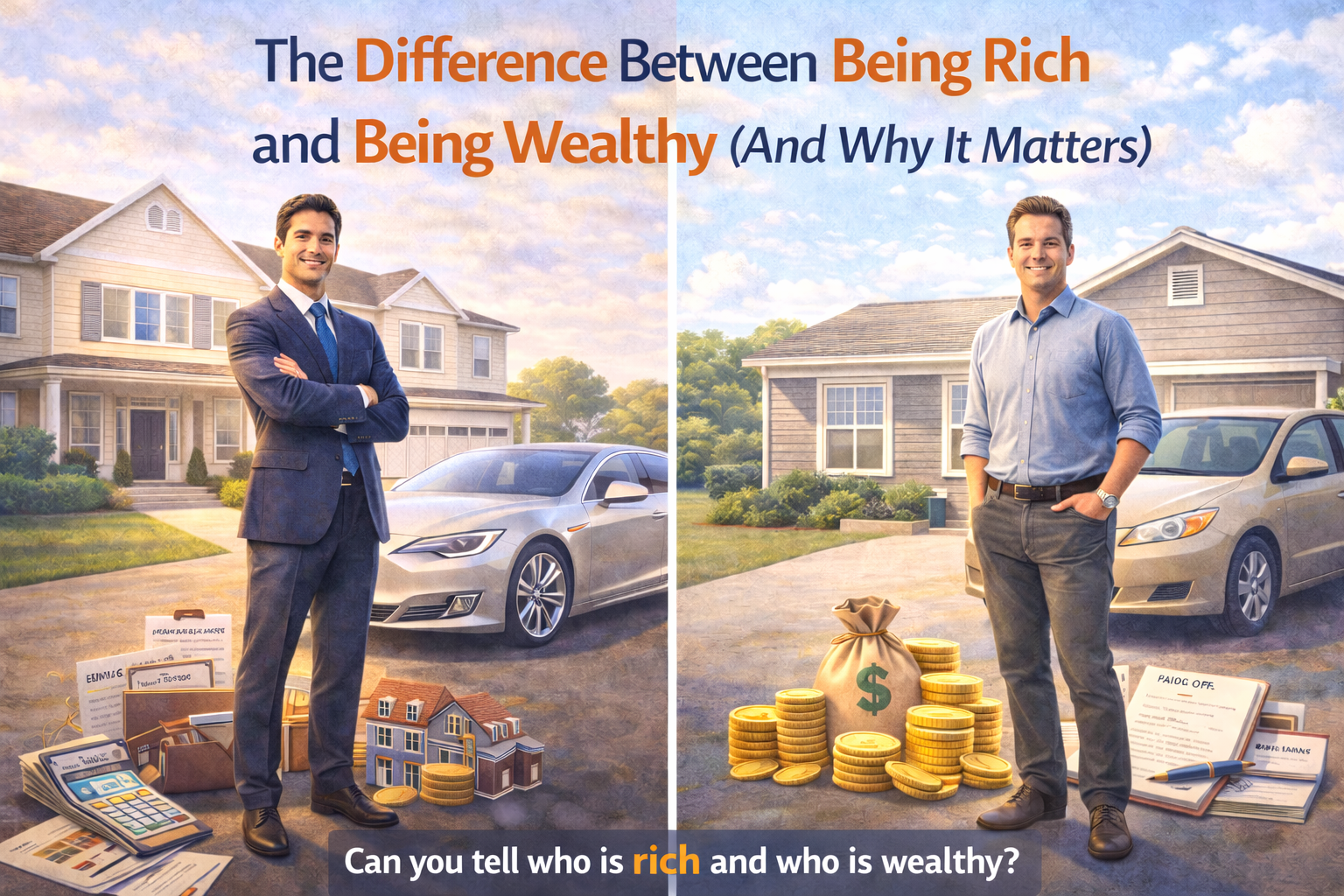
Let me tell you about two people I know.
The first one drives a Tesla Model S. Lives in a $800K house in a great neighborhood. Takes the family to Europe every summer. Wears a Rolex. Has a title that sounds impressive at dinner parties.
He makes $275,000 a year.
He's also three months away from financial disaster if he loses his job.
The second person drives a 7-year-old Toyota. Lives in a modest house worth $350K. Takes one big trip a year, maybe two smaller ones. Wears a Seiko. Most people have never heard of his job title.
He makes $140,000 a year.
He could stop working tomorrow and his lifestyle wouldn't change at all.
One of these people is rich. The other is wealthy.
And if you can't tell the difference, you're probably building the wrong thing.
Rich vs. Wealthy: The Definition Nobody Teaches You
Here's how most people think about it:
- Rich = lots of money
- Wealthy = really lots of money
But that's not it at all.
Rich is about income. Wealthy is about assets.
Rich is how much you make. Wealthy is how long you could survive without making anything.
Let me break it down:
Rich looks like this:
- High salary ($200K, $300K, $500K+)
- Nice house, nice cars, nice vacations
- Impressive lifestyle that signals success
- But... completely dependent on the next paycheck
- If the income stops, the whole thing collapses in 3–6 months
Wealthy looks like this:
- Income is optional (assets produce cash flow)
- Lifestyle is funded by investments, not labor
- Could stop working and nothing changes
- Net worth grows whether they show up or not
- Time is theirs to spend however they want
Rich is a performance. Wealthy is a position.
And here's the kicker: You can be rich and broke at the same time. But you can't be wealthy and broke—it's definitionally impossible.
The Rich Person's Trap (And Why High Earners Fall Into It)
Here's what happens when you optimize for "rich" instead of "wealthy":
You get the promotion. The salary jumps from $120K to $180K. Suddenly you can afford more.
So you upgrade:
- Bigger mortgage
- Nicer car payment
- Private school tuition
- Country club membership
- Better vacations
Your income went up 50%. Your expenses went up 50%. Your freedom went up 0%.
You're making more, but you're not more free. You're just more expensive to maintain.
And now you're trapped. Because you can't take a pay cut. You can't take a sabbatical. You can't pivot to something lower-paying but more meaningful. You can't say no to your boss without panic.
You've built a lifestyle that requires you to keep performing—forever.
That's the rich person's trap. And it's why so many high earners feel successful and stuck at the same time.
The Wealthy Person's Strategy (And How It's Completely Different)
Wealthy people play a different game entirely.
They don't ask: "How much can I make?"
They ask: "How much can I keep, deploy, and compound?"
Here's what that looks like in practice:
1. They live below their means—on purpose.
Not because they're cheap. Because they understand that every dollar not spent on lifestyle is a dollar that can buy freedom.
- They drive cars that are 3–5 years old (let someone else eat the depreciation)
- They live in houses they can easily afford (not the max the bank will lend)
- They take great vacations—but they don't finance their lifestyle with debt
The result: A gap between income and expenses that gets deployed into assets.
2. They buy assets, not liabilities.
Rich people buy things that lose value and cost money to maintain.
Wealthy people buy things that gain value and produce income.
Rich person buys:
- $80K car (depreciates, costs insurance/maintenance)
- $50K boat (depreciates, costs storage/upkeep)
- $10K watch (sits in a drawer)
Wealthy person buys:
- $250K rental property (appreciates, produces $400/month cash flow)
- $50K in dividend stocks (produces $2,000/year in passive income)
- $100K in a real estate syndication (produces 7% annual returns)
Same capital deployed. Completely different outcomes.
3. They measure wealth in time, not dollars.
Wealthy people don't ask: "What's my net worth?"
They ask: "How long could I survive without working?"
That's the real wealth metric:
- 3 months of expenses covered by assets = you're getting started
- 12 months = you have breathing room
- 24 months = you have real options
- 60+ months = you're financially free
Rich people measure success by salary. Wealthy people measure it by runway.
4. They optimize for optionality, not status.
Rich people make decisions based on how they'll look.
Wealthy people make decisions based on how much freedom they'll gain.
Rich person thinking:
- "Can I afford the payment?"
- "What will people think?"
- "Does this match my income level?"
Wealthy person thinking:
- "Does this move me closer to financial independence?"
- "Will this produce income or require income?"
- "Am I buying time or selling it?"
Status is expensive. Optionality is priceless.
The Test: Are You Building Rich or Wealthy?
Ask yourself these questions:
1. If you lost your job tomorrow, how long could you maintain your current lifestyle?
- Less than 3 months = you're rich, not wealthy
- 6–12 months = you're building, but not there yet
- 2+ years = you're wealthy
2. What percentage of your monthly expenses is covered by passive income?
- 0–10% = you're income-dependent
- 25–50% = you're making progress
- 75–100%+ = you're financially free
3. If you took a year off work, what would happen to your net worth?
- It would collapse = you're rich
- It would stay flat = you're transitioning
- It would grow = you're wealthy
4. Do you own your time, or does your job own your time?
- Job owns it = rich
- You own it = wealthy
How to Make the Shift (From Rich to Wealthy)
Step 1: Stop upgrading your lifestyle every time your income increases.
The next raise you get? Don't touch it. Auto-invest 100% of it into assets.
The next bonus? 75% goes to your next rental property down payment or investment account.
Lifestyle inflation is the enemy of wealth. Kill it before it kills your freedom.
Step 2: Start tracking passive income, not just net worth.
Create a simple spreadsheet:
- Column 1: Monthly expenses
- Column 2: Monthly passive income
- Column 3: Passive income as % of expenses
Your goal: Get Column 3 to 100%.
Step 3: Buy one income-producing asset this year.
Doesn't matter if it's:
- A rental property
- $25K in dividend stocks
- A real estate syndication
- A small business
Just buy something that pays you while you sleep.
Step 4: Redefine success.
Stop measuring success by:
- Your salary
- Your title
- Your zip code
- What you drive
Start measuring it by:
- How much time you control
- How many months you could go without working
- How much passive income you generate
- How free you actually feel
Rich is impressive. Wealthy is free.
Here's the Truth:
You can make $500K a year and be financially fragile.
Or you can make $150K a year and be financially free.
The difference isn't income. It's strategy.
Rich people earn. Wealthy people own.
Rich people impress strangers. Wealthy people buy back their time.
Rich people look successful. Wealthy people are free.
And if you're currently playing the "rich" game—chasing income, upgrading lifestyle, looking the part—it's not too late to switch.
You just have to decide what you're actually building.
Ready to stop chasing "rich" and start building wealthy?
The Financial Freedom Accelerator is an 8-week, live coaching experience that teaches you how to shift from high income to high freedom—by building cash-flowing assets, reducing taxes, and designing a life you actually own.
Led by investor and mentor Erik Hitzelberger, this isn't about making more money. It's about keeping more, deploying smarter, and building a portfolio that sets you free.
Learn More About Financial Freedom Accelerator
Because rich is what you earn.
Wealthy is what you keep.

.jpg)

Book Your Freedom Call

Client Success First
FPG Academy has taught entire groups of people and individuals how to think differently about money and investing.

Done-with-You Financial Options
We tailor every plan to your unique goals, ensuring you always receive the education that fits your goals.
.svg)
Clear, Ongoing Support
With interactive courses, supportive digital products, and access to educators within FPG Academy, we make sure all your questions get answered.
© 2025 FPG Academy All rights reserved.
Website design by My Launch Partner.svg)
.svg)
.svg)